
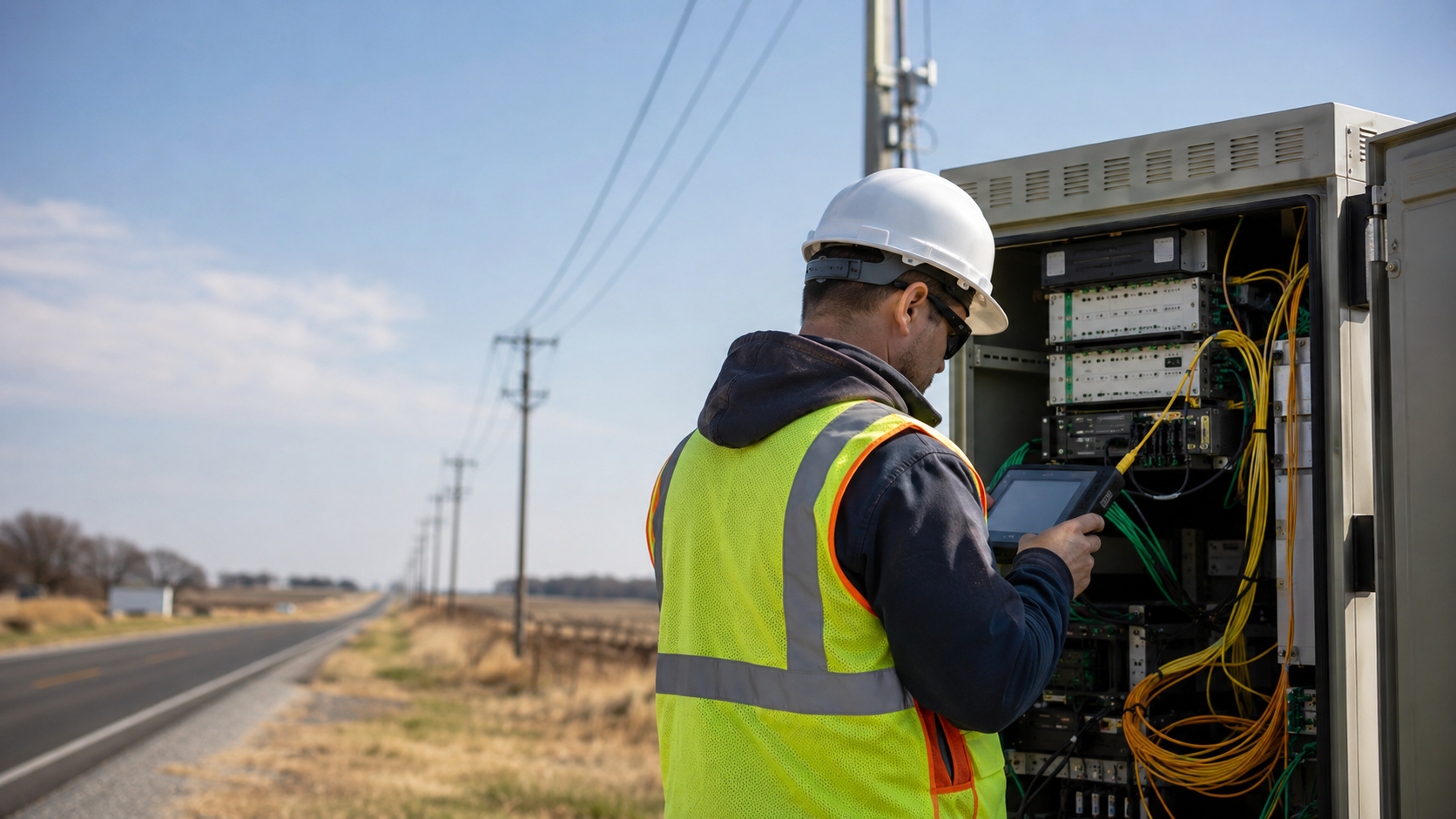
Broadband deployment programs pushed through Congress have created a genuine hiring gap across rural counties. Trade schools that build reskilling programs for working with smart machines, specifically around broadband infrastructure and network automation, are well positioned to access workforce development dollars tied to those mandates.
The core challenge is this: field roles in broadband and telecommunications now require workers who can operate sensor-driven diagnostic tools, interpret automated network alerts, and troubleshoot smart equipment in the field. That shift has outpaced most existing trade curricula. Schools that built programs around legacy cable and DSL skills are finding graduates underprepared for current job openings.
Platforms like Flashpass offer pre-built broadband credentials and the placement tracking funders require, so schools can skip the build and go straight to launch. Keep reading to learn how to structure a curriculum around smart machine skills and broadband workforce roles.
The federal broadband buildout, backed by billions in infrastructure funding, is creating demand for trained field technicians faster than trade schools can respond. Broadband installer and network maintenance roles now routinely involve smart diagnostic tools, automated fault detection systems, and remote monitoring platforms, skills that were not standard in telecommunications curricula five years ago.
A broadband installer in 2026 does more than run cable. They configure smart nodes, read automated signal diagnostics, and flag anomalies that equipment flags automatically. These tasks require a different skill set than analog splicing and manual testing.
Field roles in broadband now blend physical installation with basic data interpretation. A technician who can only perform physical installs will struggle when a smart monitoring system generates an alert they cannot read. That gap is showing up in employer feedback and in post-hire retention problems.
Schools that update their curriculum to include smart equipment operation and basic network data skills are producing graduates employers actually want to hire. That alignment also makes your program much easier to fund.
Rural counties receiving federal broadband expansion dollars face a compounding problem: they need trained local workers, but the nearest trade school may not yet offer the right credentials. Many states have created workforce funding set-asides specifically for rural telecommunications training tied to broadband deployment plans.
Programs built to serve these communities tend to score well with state workforce funders. Funders want to see that a program addresses a documented regional need, that credentials are recognized by employers in the area, and that graduates have a clear path to employment. Broadband training tied to rural deployment projects checks all three boxes when the curriculum is designed correctly.
Once you understand where the demand lies, the next step is to build your program around the specific job roles that demand creates.
Broadband and smart machine training programs that align with real hiring pipelines produce better outcomes data, which strengthens future funding applications. Two job categories drive the bulk of entry-level hiring in this sector: fiber optic technicians and network maintenance roles.
Fiber-optic technicians install, splice, and test fiber-optic cable runs for residential, commercial, and carrier-grade deployments. Broadband installers handle the last-mile connection, setting up customer-facing equipment and verifying signal quality with smart diagnostic tools. Both roles are in high demand across states receiving infrastructure buildout funds.
A well-structured program prepares learners for both roles through overlapping technical content. Core skills include fiber splicing and termination, OTDR testing, structured cabling, and basic smart node configuration. Employers in rural broadband projects specifically ask for graduates who can operate diagnostic tools without needing a senior technician on-site.
Certifications in this track, such as those built into Flashpass's broadband credential pathway, are co-developed with employers and filmed at real worksites. That worksite-grounded approach matters to funders who require evidence of employer collaboration.
Network maintenance technicians keep live broadband infrastructure running. They respond to outages, interpret smart monitoring dashboards, and perform physical repairs. Field support roles at internet service providers often require technicians to triage problems using automated diagnostic data before dispatching a repair crew.
These roles require a step up in technical complexity from initial installation. Learners need basic data literacy to read network performance metrics, familiarity with remote monitoring tools, and structured troubleshooting skills. Some employers also expect field support staff to document issues in cloud-based ticketing systems, which ties in data and AI literacy skills.
With the target job roles defined, you can map those roles back to the specific curriculum elements that make training job-ready on day one.
A 30-day program launch is achievable when curriculum is built around specific job tasks rather than broad subject areas. Trade schools that build or partner to deliver job-task-aligned content consistently outperform schools that adapt general IT curriculum to broadband roles.
Smart machine operation in broadband requires hands-on proficiency with specific tools and systems. The curriculum must cover the equipment technicians will actually touch in their first week of work, not abstract networking theory. That means OTDR testers, optical power meters, smart splitters, and the diagnostic software that reads their output.
Employers who co-develop curriculum, as Flashpass requires for every credential in its catalog, ensure that the tool coverage stays current. New equipment generations hit the field frequently in broadband, and pre-built credentials, updated quarterly, reflect that pace better than internally developed curricula, refreshed every few years.
Classroom-only broadband training produces graduates who struggle in the field. Smart machine skills are physical skills. Learners need to practice cable pulls in conduit, perform splices under simulated time pressure, and interpret diagnostic tool output in a realistic environment.
Safety training is non-negotiable in this sector. Fiber-optic work involves laser hazards, electrical proximity work, and aerial-lift scenarios in rural deployments. Programs that document safety training outcomes strengthen both their employer relationships and their grant applications, since many workforce funders require proof of compliance with an industry-standard safety curriculum.
Funders, employers, and learners all respond better to credentials with recognized names than to internal completions. For broadband and telecommunications roles, industry-aligned microcredentials that map to job tasks carry more weight with employers than general networking certificates.
Microcredentials in this space typically run four to eight weeks for working adults. That shorter duration increases completion rates and makes programs accessible to incumbent workers who need to train without leaving their current jobs. Pairing a broadband installation microcredential with a data literacy or AI tools credential creates a stackable pathway that opens doors in both field and support roles.
Once your curriculum is structured around recognized credentials and real job tasks, the next step is building the funding case that pays for it.
State and federal workforce funders have added broadband and telecommunications to their eligible training categories in direct response to infrastructure spending. Many states now route workforce dollars specifically to programs that produce job-ready graduates in broadband, cybersecurity, and related fields.
Most workforce grant applications require your program to document three things: a demonstrated regional need, an employer-aligned curriculum, and a credible outcomes measurement plan. Schools that cannot provide all three tend to score lower, regardless of how strong the program design looks on paper.
Federal programs like the Workforce Pell Grant, which becomes available for short-term programs starting July 1, 2026, and Department of Labor skills training grants provide funding for programs that meet documented employer demand.
Some states also offer workforce development set-asides tied specifically to broadband deployment goals, particularly for programs serving rural or underserved regions.
Grant reviewers look for evidence that your program was designed with employer input, not just designed for employers in the abstract. Letters of support from regional broadband carriers, ISPs, or telecommunications contractors carry real weight. So does curriculum documentation that names the employers involved in content development.
Employer partnerships also create direct placement pipelines, which show up in your outcomes data as hiring rates. Schools with documented employer relationships tend to perform better on the placement metrics funders track at renewal.
A strong first-year application helps fund your program. Strong outcomes data gets it renewed. Funders expect to see enrollment counts, completion rates, credential attainment, and placement rates broken down by program and, in some cases, by demographic group.
Programs that build outcomes tracking into their delivery platform from day one generate this data automatically rather than scrambling to reconstruct it before a renewal deadline. State-ready reporting that covers enrollments, completions, credentials issued, and employer placements is the standard most funders now require.
Knowing what funders want to see makes it easier to decide how to design and deliver the program itself.
Building a broadband curriculum internally can take 18 to 24 months, which means missing funding cycles and losing ground to regional competitors. Schools that partner for curriculum and platform delivery can launch in as little as 30 days.
Internal builds require subject matter experts, instructional designers, video production, and LMS configuration before a single student enrolls. That investment makes sense for programs at scale, but it is not the right starting point for a new credential track.
Partnering with a pre-built curriculum provider lets your school focus on enrollment, employer relationships, and grant compliance. Pre-built microcredentials in broadband, data analytics, AI, and cybersecurity already exist in employer-informed formats that funders recognize. You run the program, issue credentials in your name, and maintain your relationship with your students.
A white-labeled platform keeps your school's brand on every touchpoint. Students see your logo on the learning environment. Every credential issued carries your institution's name. Your course catalog integrates with your existing website. None of that requires internal development when the right partner handles the platform setup.
This matters to administrators because institutional identity is tied to accreditation, employer trust, and student enrollment. A white-label setup preserves all of that while removing the build burden.
Start with a pilot cohort of 15 to 20 learners. Measure completion rates and employer feedback before committing to a larger cohort. Most funding bodies support pilot launches and expect modest first-year enrollment targets.
Seat filling for the first cohort is often the hardest part. Paid search campaigns, partner outreach to regional employers, and direct referrals from workforce boards can fill a 20-seat cohort in four to six weeks when the program is clearly positioned, and the credential is relevant to local hiring needs.
Once your first cohort produces outcomes data, scaling to 50 or 100 seats in year two becomes a straightforward funding and marketing exercise. With your delivery model chosen, the final planning step is to build the proposal and evaluate any certification partners you bring into the program.
Administrators who submit strong proposals do so because they answered the hard planning questions before the deadline, not during the application process.
Work through these questions before you write a single grant narrative sentence:
Answering these questions surfaces the gaps you need to close before submission, whether that is an employer letter you still need, a placement reporting tool you have not set up, or a curriculum gap in safety training.
Not every curriculum partner can support a program from pilot to 500 seats without breaking its delivery model. When you evaluate partners, look for evidence that they have scaled programs at peer institutions, that their credentials have employer recognition in your region, and that their platform generates the outcomes data your funders will require at renewal.
Ask directly: does the partner add new credentials on a regular cycle? Can the platform accommodate growth without re-platforming? Does the partner support enrollment marketing, or do you carry that entirely?
A credible partner will answer those questions with specifics, not promises. That is the bar to hold them to before you sign anything.
Broadband, data analytics, AI for workforce, and cybersecurity are the credential areas with the strongest employer recognition for smart machine and automated equipment roles. Microcredential tracks that are co-developed with employers and updated regularly carry more weight with regional hiring managers than general IT certificates.
Many states offer workforce development grants that cover tuition and materials for employer-sponsored training programs. The Department of Labor's Industry-Driven Skills Training Fund and WIOA Title I funds both support frontline worker training in advanced technology fields when programs document employer need and track placement outcomes.
For a short-term broadband or smart machine credential, tuition typically ranges from $1,500 to $4,000 per seat, depending on program length and delivery model. Lab equipment costs vary significantly by trade, but partnering for curriculum delivery reduces upfront equipment investment. Many programs offset release time costs through employer co-funding or workforce grant stipends.
Most short-term broadband and smart machine credentials require basic math literacy, comfort with hand tools, and a high school diploma or equivalent. Programs targeting incumbent workers often include a readiness assessment to identify learners who need foundational support before the technical content begins.
Programs should track credential attainment at the individual learner level from day one using a platform that generates state-ready reports. Placement rates are best measured 90 and 180 days post-completion through direct employer feedback and learner follow-up surveys. Wage gain data, when required by funders, is typically sourced through state wage record matching.
Direct employer co-development of curriculum is the most reliable alignment method. Schools should convene employer advisory groups in each sector, review job postings for required competencies at least quarterly, and require employers who want preferred hiring access to sign letters of support that document the skills they need.
Credential areas such as oil and gas, broadband, and rural health each have distinct technical vocabularies and safety standards, so alignment should occur at the credential level, not just at the program level.
Reskilling programs for working with smart machines succeed when they are built around real job roles, funded through the right grant streams, and delivered through a model that can scale without breaking your institution's capacity.
The practical planning steps in this guide (defining target job roles, aligning curriculum with employer input, choosing the right delivery model, and building your outcomes tracking from day one) are the same ones that funders reward at renewal. Start with those and your proposal will be stronger before you write a single narrative section.
When you are ready to see how a platform handles credentialing, outcomes reporting, and enrollment at scale, book a demo with Flashpass and see exactly how it works for trade schools and workforce agencies building programs in broadband, AI, data analytics, and beyond.

The workforce platform for trade schools.
